
Eagle River Police Blotter Records
The Eagle River police blotter reflects law enforcement activity in one of Anchorage Municipality's largest communities, located about 12 miles northeast of downtown Anchorage. Eagle River is part of the Municipality of Anchorage, and law enforcement here is handled by the Anchorage Police Department through its Eagle River Substation. All public records requests for police reports, incident records, and arrest logs go through the APD Public Records Center, following the same process as the rest of the municipality. This page explains how to get Eagle River police records, search court case filings, and use Alaska's statewide tools for related criminal records research.
Eagle River Overview
Eagle River Police Records Through APD
Eagle River is a community within the Municipality of Anchorage, which means the Anchorage Police Department handles all law enforcement here. APD operates an Eagle River Substation to serve the local area, but all police records for Eagle River incidents are processed through the APD Public Records Center. That is your starting point for getting a copy of an incident report, arrest record, or other police document tied to an Eagle River case.
APD's records process has a few rules worth knowing before you submit. Each case or incident requires its own separate request form. You cannot bundle multiple cases into one submission. If your case involved both written documentation and video footage, such as body cam or dash cam recordings, those count as separate requests. Documents and digital media are handled through different request tracks. Having the incident date, case number if available, and the names of involved parties ready will help staff locate the right record.
Consent requirements apply in certain situations. Requests involving your own records use a standard adult consent form. Records involving a minor require a parent or guardian's signature. Requests for records about an incapacitated adult require the appropriate guardian consent documentation. APD will not release records without the right consent forms in these cases. Plan ahead if your request involves any of these scenarios, as missing documentation will add delays to your request.
Eagle River Police Blotter and the APRA Framework
All public records requests in Eagle River, like those across the municipality, are governed by the Alaska Public Records Act. The APRA guidelines define what agencies must disclose, how quickly they must respond, and what fees are permitted. For the full statutory text, the law is codified at AS 40.25.120. Knowing your rights under the APRA is useful if a request is denied or you believe the agency is not following the required process.
Some records are exempt from disclosure under state law. These include records tied to active investigations, certain personal information protected by privacy rules, and records involving juvenile subjects. When APD denies a request or redacts a portion of a record, they are required to provide a written explanation citing the applicable exemption. You have the right to appeal a denial. The APRA framework sets out how that process works.
The Alaska JustFOIA portal handles formal public records requests to state DPS agencies. For Eagle River incidents handled by APD rather than state troopers, use APD's own records center instead.
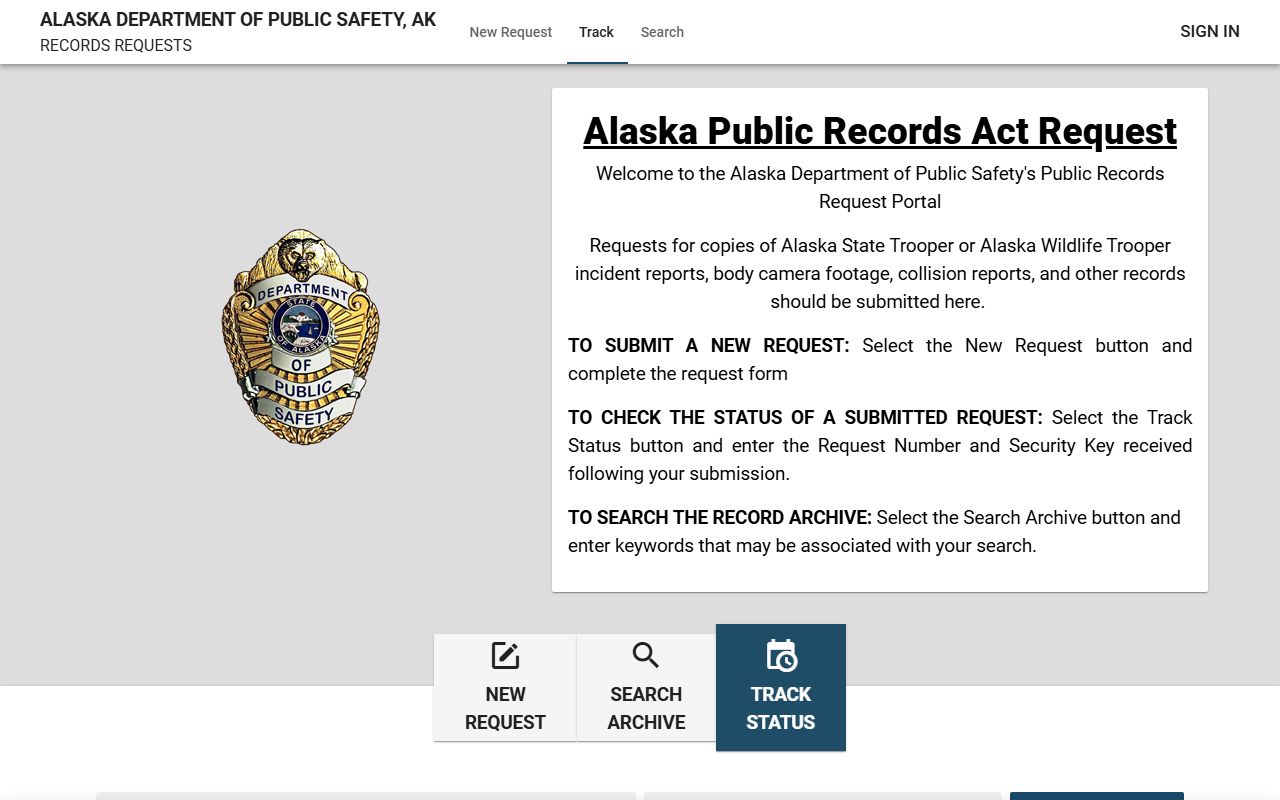
JustFOIA is the right channel when the incident involved Alaska State Troopers rather than city or municipal police. For APD Eagle River cases, use the APD Public Records Center directly.
Alaska State Troopers and Eagle River
While APD handles most law enforcement within the Municipality of Anchorage, the Alaska State Troopers can have jurisdiction in certain situations, and AST covers areas along the Glenn Highway and beyond the municipal boundary. For incidents that fall under trooper jurisdiction, the Alaska DPS Daily Dispatch logs trooper activity statewide. AST C Detachment covers the Anchorage and Eagle River area. The Daily Dispatch is a public tool updated regularly with trooper incident reports. It is a useful starting point when you are unsure which agency handled a call.
For formal records requests directed at AST or other DPS agencies, use the JustFOIA portal. This system handles online submissions for state agency records requests. The key point is that APD and AST are separate agencies with separate records systems. If you send a request to the wrong agency, you will get a referral rather than the record. Identifying which agency responded to the incident first saves time.
Eagle River Police Blotter and Court Records
When an Eagle River police blotter incident results in criminal charges, the case enters the court system. Misdemeanor charges and traffic violations from Eagle River are handled by the Anchorage courts. The Anchorage Municipal Court at 825 West 4th Avenue, phone 907-343-4130, handles city ordinance violations and misdemeanor cases. Felony charges go to the Third Judicial District Superior Court, also in downtown Anchorage.
Alaska's CourtView portal provides online access to case filings from courts across the state. You can search by party name, case number, or attorney. CourtView covers both district and superior court filings and shows docket entries, case status, hearing dates, and charges. Not all Eagle River police blotter incidents result in court filings. Prosecutors review arrests and may decline to file charges. Cases can also be resolved through diversion or dismissed early in the process. The police record and the court record are two separate documents, maintained by different agencies, and they don't always line up.
Municipal court records for lower-level ordinance cases may not appear in CourtView. For those, contact the Anchorage Municipal Court directly. CourtView is best for district and superior court cases that resulted from police blotter incidents involving criminal charges.
Statewide Records Tools for Eagle River
Alaska maintains several public tools that apply to Eagle River police blotter research. The Active Warrants database lists individuals with outstanding warrants statewide, including those from Anchorage Municipality cases. The Sex Offender Registry covers all registered offenders in Alaska and can be searched by name or by location. Registrants living in Eagle River appear in the same statewide database as offenders elsewhere in Alaska. Both tools are free and publicly available without a formal request process.
For individuals held in custody following an Eagle River arrest, the most likely holding facility is the Anchorage Correctional Complex at 1400 East 4th Avenue, operated by the Alaska Department of Corrections. The DOC Offender Locator shows current facility assignments and basic status for anyone in the Alaska correctional system. This tool is free to use and does not require a formal records request. It reflects current or recent custody status rather than historical records.
For official criminal history records, individuals can request their own history through the DPS self-service background check. The Alaska Bureau of Investigation maintains the state's central criminal history repository, which reflects statewide arrest and court disposition data. ABI records are more complete than any single blotter entry and cover an individual's full criminal history across Alaska.
Eagle River Community Context for Records Research
Eagle River is the largest community within the Municipality of Anchorage outside of Anchorage proper, and it has grown significantly over the past few decades. The community sits along the Glenn Highway in the Chugach Mountain foothills. Its population includes many families and commuters tied to both local and Anchorage employment. The volume of police blotter activity in Eagle River reflects a community with active residential neighborhoods, commercial areas along the Old Glenn Highway corridor, and occasional incidents tied to highway traffic and surrounding rural access routes.
Because Eagle River is part of the municipality rather than an independent city, it does not have separate city departments or a standalone police department. Everything runs through Anchorage Municipal systems, which means there is no separate Eagle River city clerk or standalone Eagle River court. Records requests, court filings, and administrative matters all go through the same Anchorage municipality channels. This makes things simpler in some ways but can mean longer wait times given the overall volume of requests APD and the courts handle across the full municipality.
Alaska State Archives and Historical Eagle River Records
For older Eagle River police blotter records or historical law enforcement documents, the Alaska State Archives may hold relevant materials depending on the age of the record and the originating agency. The archives maintain historical government records from agencies across Alaska. Recent records are held by the originating agencies: APD for police reports, the courts for case files. Older records, particularly those no longer in active agency systems, may have been transferred to the archives. Contacting the originating agency first is the right step; the archives are a secondary option for historical research when agency systems no longer hold the data.
Nearby Cities
For records at the municipality level, see the Anchorage Municipality records page.